

 Türkçe
 Deutsch
 Français
 Español
 Русский


The New Reality of Case Packer Machines: Speed, Control and Traceability
What Is Case Packing?
At its core, a case packer machine is the final step of the packaging process where individual products—typically cartons or bundles—are grouped and placed into shipping cases.
This process plays a critical role in product protection, logistics efficiency, and increasingly, traceability within modern case packing systems.
For many manufacturers, case packing starts as a simple operational task. Products arrive at the end of the line, operators place them into cases, and the process moves forward.
But as production grows, this step often becomes one of the most complex parts of the entire line, especially when transitioning to an automatic case packing system.
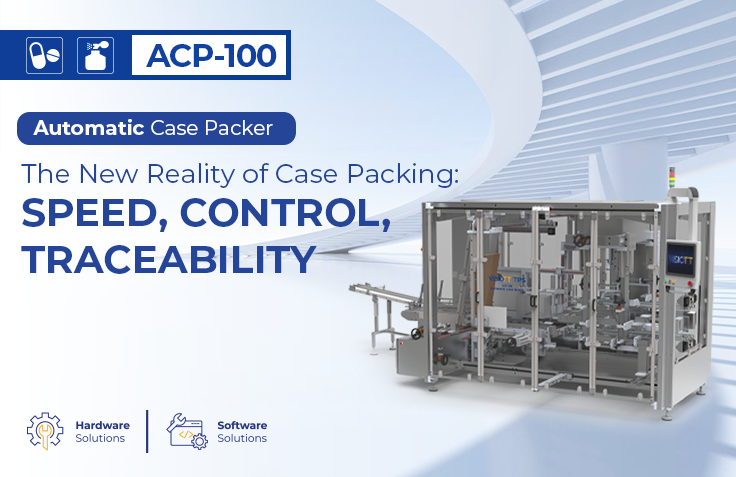
When Case Packing Stops Being Simple
Over time, several shifts begin to challenge traditional approaches:
- Production speeds increase, requiring more reliable case packer machine performance
- Product variety grows, demanding flexibility in the case packing system
- Labor dependency becomes a cost and consistency risk
- Traceability expectations expand—even in markets where it is not strictly mandatory
What was once a straightforward packing task turns into a critical decision point:
“Should a case packer machine simply automate packing, or also manage product-level data?”
Automation Solves One Problem—But Not All
The first natural step for many manufacturers is to implement an automatic case packing system.
Modern case packer machines help:
- Stabilize line performance
- Reduce reliance on manual labor
- Ensure consistent packing quality
- Enable high-speed, continuous production
At this stage, the focus is clear:
move products efficiently from the line into cases with minimal interruption.
However, as operations mature, a new layer of need often emerges—not physical, but digital.
Where Case Packing with Aggregation Changes the Game
In some cases, it is no longer enough to know that products are packed correctly. Manufacturers may also need to answer questions like:
- Which serialized units are inside this case?
- How are these products linked within the supply chain?
- Can this relationship be verified and reported?
- This is where case packing with aggregation becomes essential.
Aggregation creates a data hierarchy:
unit → case
case → pallet
Once this requirement appears, the role of the case packer machine changes fundamentally.

Two Different Approaches to Case Packing
At this point, two distinct approaches begin to take shape.
Fully Automatic Case Packing
(VISIOTT ACP-100)
In high-speed environments, the priority is often performance and efficiency.
Automatic case packers:
- Fully automated packing process
- High speed and repeatability
- Minimal operator intervention
- Consistent output quality
These systems focus on efficiency, while allowing future integration of aggregation if needed.
Semi Automatic Case Packing with Built-in Aggregation
(VISIOTT SACP-100)
In other environments, aggregation is required from the beginning.
Here, the system is designed not only to pack products, but also to:
- Builds parent–child relationships
- Ensures data accuracy
- Supports track & trace processes
These systems are typically semi-automatic, allowing controlled interaction where needed to guarantee correct aggregation.
This approach combines packing and data management in a single step.
So, Which One Is the Right Choice?
There is no universal answer—only the right fit for a specific operation.
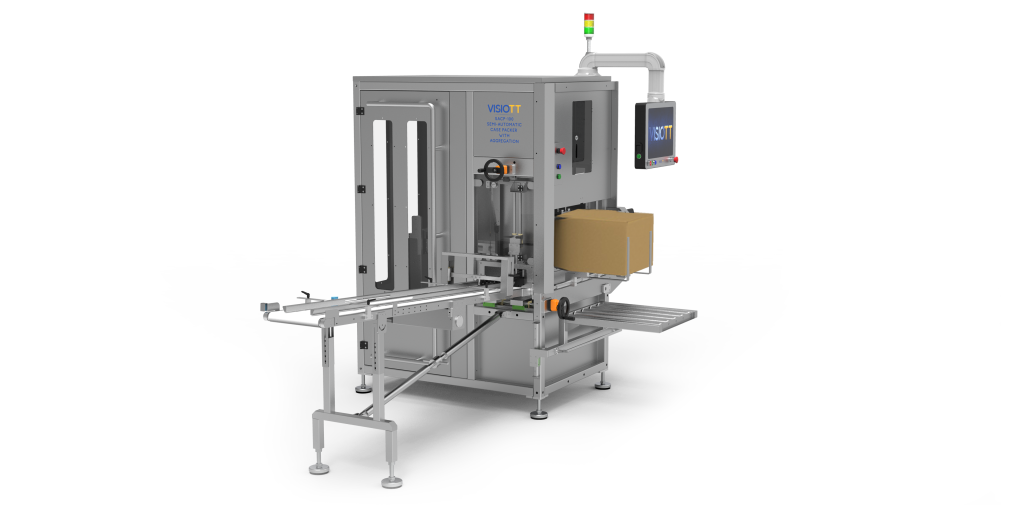
If the requirement includes traceability at case level with strict data hierarchy, aggregation becomes essential from the start …..Then choosing SACP-100 is the right answer.
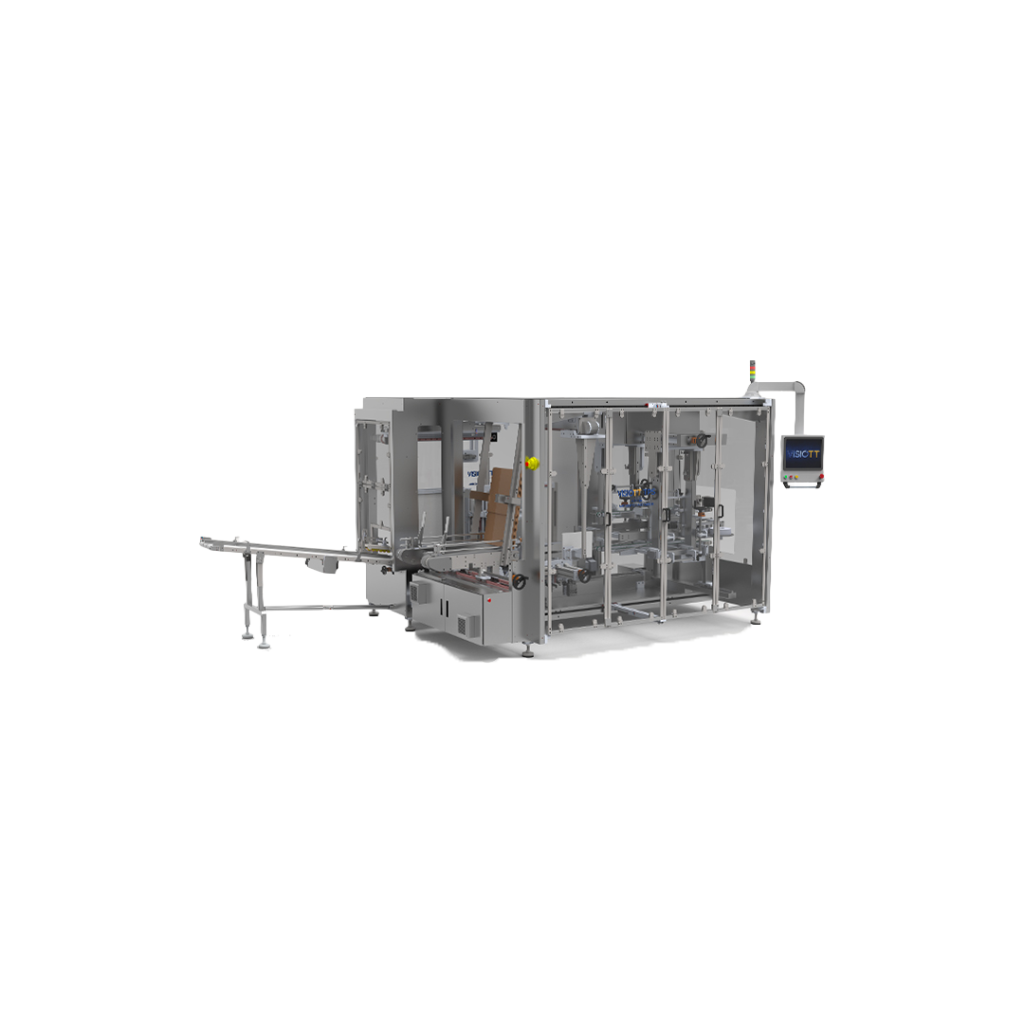
If the main challenge is speed, efficiency, and reducing manual work, a fully automatic approach is often the logical step …… Then choosing ACP-100 is the right answer.
What adds another layer to this decision is this:
One approach is aggregation-ready
The other is aggregation-native
Conclusion: It’s Not Just About Case Packing Anymore
Case packing has evolved from a mechanical task into a strategic part of the production line.
Today, the real question is not how to pack products into cases—but what this step needs to deliver: speed, control, traceability, or all three.
By choosing the right case packer machine, manufacturers can align their operations with both current needs and future requirements, while ensuring compliance with global standards such as GS1 traceability standards.
Frequently Asked Questions
A case packer is an automated system that organizes products and places them into shipping cases. It is essential for ensuring secondary packaging efficiency, reducing manual labor costs, and maintaining high-speed production lines in industries like pharmaceuticals and food.
Top-load case packers lower products into the case from above, ideal for fragile items or vertical orientations. Side-load case packers push products horizontally into the case, which is often faster for uniform items like cartons or rectangular boxes.
Automatic case packers, especially those from VISIOTT, can integrate with serialization and aggregation systems. This allows each case to be tracked with a unique label, ensuring full traceability and compliance with global regulations.
Automated case packing is critical for industries with high-volume production and strict regulatory requirements, such as pharmaceuticals, cosmetics, food and beverage, and FMCG sectors.
Key factors include production speed (cases per minute), product dimensions, flexibility for different case sizes, footprint in the facility, and the machine’s ability to integrate with existing production line software.


